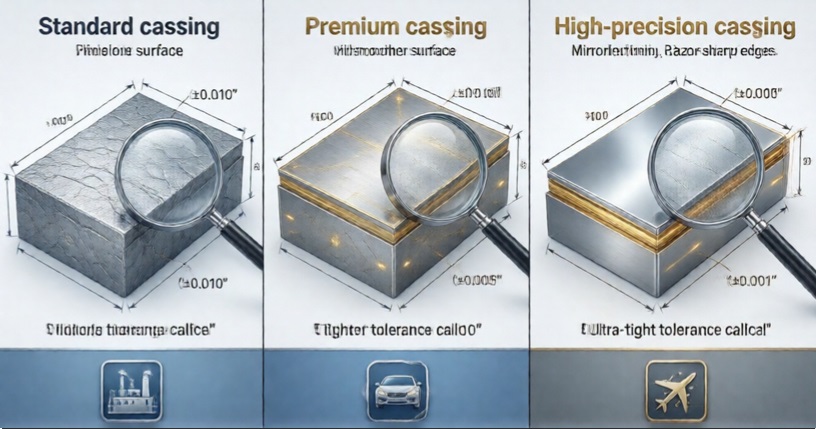
This is the million-dollar question—and where marketing brochures often get separated from shop-floor reality. Managing expectations here is critical; I’ve seen projects go sideways because someone assumed they’d get a machined finish straight out of the mold.
Let’s talk brass tacks about what’s achievable, what’s difficult, and where you’ll absolutely need a secondary operation.
The Guiding Principle: “As-Cast” vs. “Finished”
The first mindset shift is to stop thinking of an investment casting as a final part, but rather as a near-net-shape blank. Its purpose is to get you 95% of the way there with minimal waste. That last 5% determines your cost and process.
Dimensional Tolerances: The Real Numbers
Forget the theoretical bests. Here’s what I reliably specify, based on years of reviewing first-article inspection reports:
- Linear Dimensions (Standard): ±0.005 inches per inch (±0.127 mm per 25 mm) is the industrial workhorse tolerance. For a 4-inch (100 mm) part, you’re looking at ±0.020 inches (±0.5 mm). This is achievable consistently with a robust process.
- Linear Dimensions (Precision/High-Engineering): With exceptional process control—including stable room temperature for wax assembly, dedicated tooling, and statistical process control—you can push to ±0.003 inches per first inch, and ±0.0015 per additional inch. This is for aerospace or medical-grade foundries.
- Critical Dimensions (With Process Aids): This is a key nuance. If a dimension is absolutely critical (like a bearing seat diameter), you design in a machining stock allowance (typically 0.010-0.030 inches/side). You then machine it post-casting. The casting gets you close; machining gets you perfect.
- Geometric Tolerances (Flatness, Roundness): This is where casting has inherent limits. Don’t expect a cast surface to be truly flat or a cast hole to be truly round without machining. As-cast, you might see 0.010-0.015 inches of variation over a 4-inch surface. If you need better, you machine a face or bore a hole.
- Pattern vs. Production: Remember, your first article from the prototype pattern will have slightly wider tolerances. Production runs from hardened steel tooling will be tighter and more consistent.
Surface Finishes: Reading the RMS
Surface finish is measured in microinches (μin) Ra (roughness average). A lower number is smoother.
- Typical As-Cast Surface: 125 μin Ra is the standard benchmark. To the naked eye, it looks like a fine, satin finish. You can feel the grain. For many non-wearing, non-sealing internal components, this is perfectly acceptable.
- Excellent As-Cast Surface: With fine-grade ceramic stucco and careful shell processing, a good foundry can achieve 63-90 μin Ra. This feels noticeably smoother.
- The “Glass Smooth” Myth: Claims of 32 μin Ra or lower as-cast are, in my experience, usually based on a perfect sample measured in one ideal spot. It’s not repeatable over an entire part surface. To get there, you need post-processing.
- The Reality of Inconsistency: This is crucial—surface finish will vary on different faces of the same part. The “cope” (top) surface will always be slightly rougher than the “drag” (bottom) surface due to micro-inclusions rising. Vertical walls are often smoother than horizontal ones.
Post-Casting Pathways to Perfection
Here’s my practical playbook for achieving tighter specs, based on the function of the feature:
- For Sealing Surfaces (Gasket faces, O-ring grooves):
- Expectation: Must be machined.
- Process: Leave 0.020″ stock. A light skim cut on a lathe or mill brings you to 32 μin Ra or better.
- For Bearing or Bushings Surfaces:
- Expectation: Must be machined and often ground/honed.
- Process: Leave 0.030″+ stock. Turn to size, then grind for perfect roundness and a 16-32 μin Ra finish.
- For Cosmetic/Ergonomic Surfaces (Handles, housings):
- Expectation: Can often be improved from as-cast.
- Process: Vibratory finishing or media blasting (with glass bead or ceramic media) can improve an as-cast 125 μin to a uniform 60-90 μin with a pleasing matte look. This is cost-effective for high volumes.
- For Threads:
- Golden Rule: Never specify cast-in threads for anything critical. The dimensional variation and potential for ceramic inclusion make them unreliable. You tap or thread mill after casting. I only allow cast threads for things like decorative knobs or non-load-bearing access panels.
The Hidden Variables Practitioners Know
- Alloy Matters: Fluidity is key. A beautiful, fluid aluminum alloy (like A356) will fill a mold more crisply than a sluggish superalloy, yielding slightly better surfaces and sharper features.
- Feature Size vs. Tolerance: It’s easier to hold a tight tolerance on a small feature than a large one. Asking for ±0.002″ on a 6-inch span is asking for process heroics and a high scrap rate.
- The “No-Load” Dimension Trick: If you have a dimension that sees no load and just needs to look precise (e.g., the outer diameter of a decorative flange), design it as a non-critical reference dimension on your drawing. This gives the foundry the breathing room they need to manage shrinkage, and you avoid paying for an unnecessary tolerance.
My Actionable Framework for Specifying Tolerances:
- Classify Every Dimension on Your Drawing:
- Class A (Critical, Functional): These get a tight tolerance and mandatory machining stock callout.
- Class B (Important, Non-Critical): Assign the standard ±0.005″/inch tolerance.
- Class C (For Reference Only): Put these in parentheses or label as “REF.” This tells the foundry they can float.
- Always Include a General Tolerance Block: Something like: “±0.010″ unless otherwise specified. Tighter tolerances require machining.”
- Communicate with Your Foundry Engineer Early: Send them a preliminary print. Say, “These three bore diameters are for bearings and will be machined. These outer profiles are cosmetic.” They will guide you on stock allowances and point out features that are inherently difficult to cast tightly (like the distance across a parting line).
Bottom Line: You can expect remarkable dimensional accuracy and decent surface finish from modern investment casting—but only within its process-based windows. The real engineering skill is knowing which features live comfortably within that window, and which require a deliberate, planned secondary operation. It’s about strategic design, not hoping for a miracle from the mold.
Would you like to walk through a specific feature or tolerance challenge you’re facing? Often, a real example is the best way to crystallize these principles.
No Responses