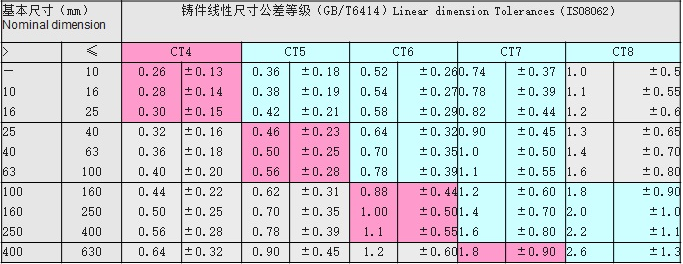
Investment Casting Materials list we use:
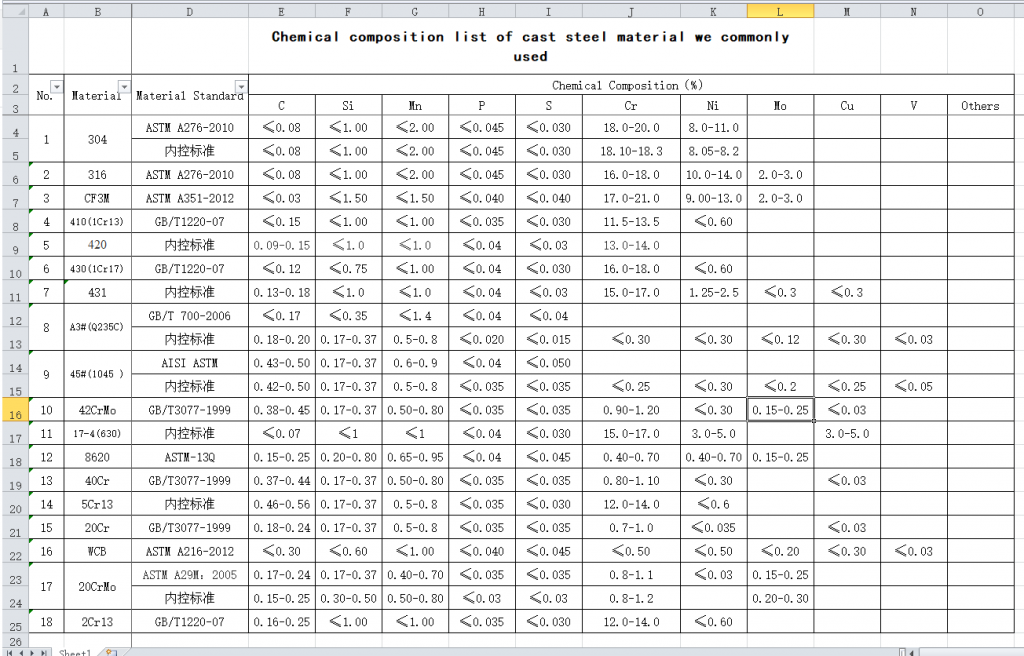
Tolerance for investment Casting
USA Investment Casting Linear Tolerance (ICI, USA)
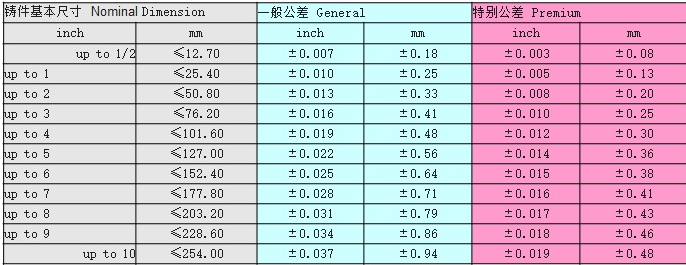
ISO Linear Dimension Casting Tolerances(GB/T6414 eqvISO8062)
When you’re sourcing critical components, a list of materials and tolerance tables can feel abstract. In my view, these aren’t just specs on a page; they are the tangible proof of a controlled, repeatable process. They represent the boundaries within which we consistently operate to deliver reliability. Let me walk you through what our capabilities mean for your project.
Our Material Palette: More Than Just a List of Alloys
We don’t just “use” these materials; we understand their personalities. Selecting the right alloy is the first and most critical decision in ensuring a component’s success. Our commonly used investment casting materials include, but are not limited to:
- Carbon Steels & Low-Alloy Steels: The workhorses. Ideal for high-strength structural components where cost-effectiveness is key. We often use these for automotive, construction, and heavy machinery parts.
- Stainless Steels (304, 304L, 316, 316L, 17-4PH, etc.): This is where we do a significant portion of our work. Each grade serves a distinct purpose. For instance, I almost always guide clients toward 316L for superior corrosion resistance in marine or chemical environments, while 17-4PH is my go-to for components requiring high strength and hardness post heat-treatment.
- Tool Steels (P20, H13): Essential for molds, dies, and applications requiring exceptional wear resistance and stability under thermal cycling.
- Heat-Resistant Steels & Superalloys (HK30, IN718, etc.): These are the specialists for the most demanding environments. If your part is facing temperatures that would make other steels soft, this is the category we dive into. We have specific expertise in the controlled processes these high-performance alloys demand.
The real conversation begins when we discuss your component’s operating environment—the stress, the temperature, the corrosive agents. That’s where our 15 years of metallurgical experience turns a specification into a solution.
Understanding Tolerance: The Language of Precision
Tolerance isn’t just a number; it’s a promise of consistency. We adhere to internationally recognized standards to give you a clear, unbiased benchmark for what to expect.
You’ll see references to two primary standards on our site:
- USA Investment Casting Linear Tolerance (ICI, USA): This is a well-established standard in North America. It provides excellent, commercial-grade tolerances that are sufficient for a vast majority of industrial applications. When you see this standard, you’re looking at a proven, reliable baseline for precision.
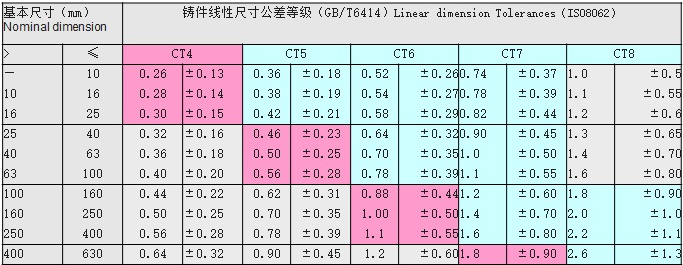
- ISO Linear Dimension Casting Tolerances (GB/T6414 eqv ISO8062): This is the global benchmark. The ISO 8062 standard is rigorous and provides a comprehensive framework for dimensional accuracy across a wider range of nominal sizes. Working to this standard demonstrates a commitment to a level of precision that is accepted and respected in international markets, from Europe to Asia.
What this means in practice: For a typical dimension, we can routinely hold tolerances equivalent to ISO 8062 CT6-CT7 (or better) as a standard. This translates to incredibly tight control—for a 100mm dimension, we’re talking about a tolerance zone of just ±0.35mm to ±0.55mm, right out of the mold. And on critical features, we can often do even better.
The Critical Nuance: “Standard” vs. “Critical” Tolerances
This is a insight you only gain from experience: not every dimension on a drawing needs to be held to the tightest possible tolerance. Doing so unnecessarily drives up cost.
Here’s how we think about it:
- Standard Tolerances: Apply to non-critical features, envelope dimensions.
- Critical Tolerances: These are for your datums, your mounting points, your sealing surfaces. We achieve these through a combination of process control and, if necessary, selective CNC machining.
Our engineering team’s value lies in identifying which dimensions are critical for your function and focusing our efforts there, saving you money on the features where it doesn’t matter.
In summary, our technical capabilities are not just a list of what we can do. They are a commitment to how we do it: with a deep understanding of materials, a disciplined adherence to international standards, and the practical wisdom to apply the right level of precision where it counts.
Let us put these capabilities to work for you. Send us your most challenging print. We’ll provide a free DFM analysis that shows you exactly which tolerances are achievable and which alloy will perform best in your application.
No responses yet